Custom Software vs Off-the-Shelf: How to Actually Decide
Deovate World

Custom Software vs Off-the-Shelf: How to Actually Decide

Amit Sharma Amit Sharma
Jun 17, 2026 5 min read 3161 views

Almost every growing business hits this decision eventually: keep patching together off-the-shelf tools that mostly work, or invest in something built specifically around how the business actually operates. Both are legitimate choices in the right circumstances, but most businesses make this call based on upfront cost alone, which is exactly the wrong way to evaluate it. Upfront cost is the easiest number to compare and the least informative one, because it ignores everything that happens after the purchase decision is made.

Why This Decision Gets Made Badly

Off-the-shelf software always wins on day-one price. It is faster to set up, requires no development timeline, and comes with a support team already in place, so it becomes the default choice for most teams operating under time pressure or budget scrutiny. The real cost of that decision rarely shows up immediately. It shows up months or years later, in the accumulation of workarounds, manual data re-entry between disconnected systems, and the quiet normalization of "we just do it this way because the tool cannot" as an accepted part of daily operations.

By the time a business notices how much time and money those workarounds are actually costing, switching becomes its own expensive project, migrating data, retraining staff, untangling processes that were built around the tool's limitations rather than the business's actual needs. This is why the decision deserves more rigor upfront than most businesses give it.

Five Questions That Actually Determine the Right Choice

  1. Is your workflow genuinely standard, or does it have real business-specific logic a generic tool cannot represent? Most accounting and generic HR functions are standard enough that off-the-shelf software fits well. Highly specific operational logic, custom pricing rules, unique approval chains, industry-specific compliance steps, often does not fit any generic tool cleanly.
  2. How many people will use this daily, and does per-seat licensing cost scale badly at that number? A tool that costs very little with five users can become surprisingly expensive at fifty, and that cost compounds every year going forward with no ceiling.
  3. Do you need this system to integrate deeply with two or more other tools you already depend on? Off-the-shelf tools vary wildly in how open and reliable their integration options actually are, and a system that needs to be the connective tissue between several other systems often benefits from custom-built integration logic.
  4. Is this process core to your competitive advantage, or is it a commodity task every business in your industry does the same way? Building custom software around a genuinely differentiating process can be a real advantage. Building custom software around something completely standard is usually wasted effort.
  5. Are you planning to scale significantly in the next two to three years in a way a generic plan tier might not support? Growth plans matter more than current size when evaluating long-term software fit.

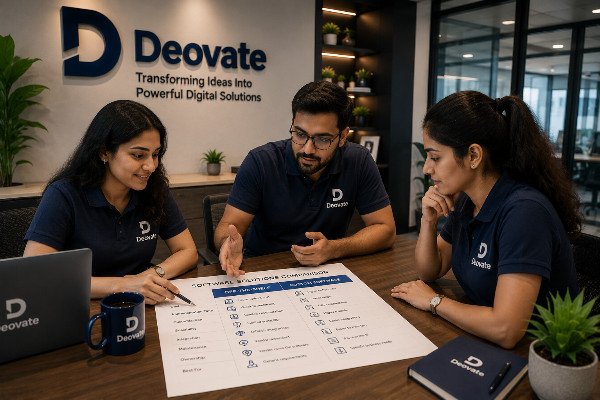
Comparison at a Glance

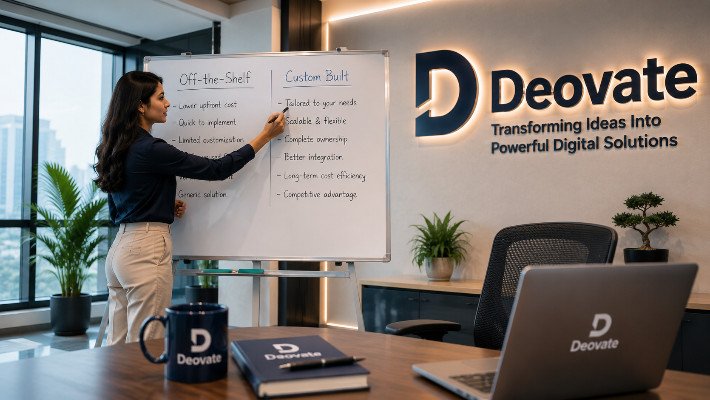
Factor Off-the-Shelf Software Custom Software
Upfront Cost Low Higher
Long-Term Cost at Scale Grows with per-seat fees Fixed after build, no per-seat fees
Fit to Your Exact Workflow Approximate, requires workarounds Exact, built around your process
Ownership You rent access You own the system outright
Time to Launch Immediate Weeks to months depending on scope

The Hidden Cost of "Good Enough"

Generic software rarely fails outright, it simply becomes "good enough," and good enough has a way of quietly capping how efficiently a team can operate. Employees learn to work around limitations instead of flagging them, because raising the issue feels like more effort than just doing the extra manual step. Over time, this creates an invisible tax on productivity that never appears on any invoice, but shows up clearly in how much longer certain tasks take compared to a business with tooling actually built for its process.

This is the argument that upfront cost comparisons miss entirely. A five thousand rupee monthly software subscription looks cheap next to a one-time custom development cost, until you calculate the value of the hours lost every month to workarounds that a properly fitted system would have eliminated.

When Off-the-Shelf Genuinely Wins

None of this is an argument that custom software is always the right call, it frequently is not. A small team handling standard accounting, generic project management, or common HR functions is almost always better served by a mature, well-supported off-the-shelf tool. These categories are so standardized that building something custom would mean reinventing years of accumulated product refinement for no real benefit. The right question is never "custom or off-the-shelf" as a blanket policy, it is "custom or off-the-shelf" evaluated separately for each distinct function in the business.

The Middle Path Most Businesses Miss

It rarely has to be one extreme or the other across the entire business. Many businesses get the best outcome by keeping standard off-the-shelf tools for genuinely standard functions, generic accounting software, common email platforms, while building custom software only around the specific processes that actually differentiate how they operate or where a generic tool creates measurable friction. That hybrid approach controls cost while still solving the real bottleneck, instead of either over-investing in custom development for commodity tasks or under-investing in the one process that actually needs it.

How to Start the Evaluation Properly

Before committing to either path, map out your actual current workflow in detail, every manual step, every workaround, every place data gets copied between systems by hand. This exercise alone often reveals exactly where the real cost is hiding, and makes the custom-versus-off-the-shelf decision far more obvious than it seemed at the start. A good development partner should be willing to sit through this mapping exercise with you honestly, including telling you when an off-the-shelf tool is genuinely the better answer, rather than defaulting to recommending a custom build regardless of fit.

Final Thought

The right decision is rarely about which option is cheaper today. It is about which option costs less, in time, friction, and flexibility, three years from now, once your business has grown into whatever it is becoming.

Gallery

Written by
Amit Sharma
Amit Sharma
Senior Technology Writer
Have a project in mind?

Let's talk about how we can help bring it to life.

Contact Us
Leave a Comment

Share your thoughts on this article

Comments are reviewed before they appear publicly.

0 Comments

Be the first to comment on this article.

More Articles

Brand Identity Mistakes That Are Quietly Costing You Trust

Brand Identity Mistakes That Are Quietly Costing You Trust

Most branding mistakes are not dramatic, they are small inconsistencies that quietly accum...

ERP vs CRM: What Growing Businesses Actually Need First

ERP vs CRM: What Growing Businesses Actually Need First

These two systems get confused constantly, and businesses often invest in the wrong one fi...

Why Skipping QA Testing Costs More Than It Saves

Why Skipping QA Testing Costs More Than It Saves

Skipping or shortcutting QA is one of the most common cost-cutting decisions teams make un...

Our Development Process

From Vision to Digital Success

Every project we take on moves through the same four stages, not because we lack flexibility, but because skipping steps is exactly how good ideas turn into messy builds. Here's what that looks like in practice.

01 Discovery
02 Planning
03 Development
04 Launch
Deovate/process
Trusted by Businesses Worldwide

What Our Clients Say

Discover how our technology solutions have helped businesses innovate, grow, and achieve lasting success through trusted partnerships and measurable results.

Deovate/reviews
Start Your Digital Journey

Let's Build Something Exceptional

You've seen how we think and how we work. Here's where it turns into your project.

You've read about how we think, who leads the work, and what a project with us
actually looks like day to day. The next step is simple: tell us what you're building, and we'll tell
you honestly whether we're the right fit - and if we are, exactly what that plan looks like.

Start Your Project
FAQs

Frequently Asked Questions

Still have a question after reading about our team and process? Here are the ones people ask most.

Deovate

FAQs

Quick answers to common questions

What's the actual first question I should ask myself before deciding between custom and off-the-shelf?

Whether your workflow is genuinely unique, or whether it just feels unique because it's the way you've always done it. Off-the-shelf tools are built for the common version of a problem, and a lot of businesses assume their process is special when it would actually adapt fine to an existing tool with some minor adjustment. The businesses that truly need custom software are usually the ones where the off-the-shelf tool forces a compromise that costs them real time or money every single day it's in use.

Isn't off-the-shelf always cheaper, since custom software has a big upfront cost?

Cheaper on day one, not necessarily cheaper long-term, which is exactly the trap this decision often hides. A subscription tool's monthly cost is small individually, but it compounds indefinitely for as long as you use it, and it often comes bundled with limitations that cost you time working around them. Custom software has a bigger upfront investment but no ongoing license fee and no forced compromise - whether that trade-off is worth it depends entirely on how long you'll actually be using the system and how much the workaround costs you today.

What's a clear sign that off-the-shelf software is actually the wrong fit for a business?

When your team has built an elaborate set of manual workarounds - spreadsheets, extra approval steps, duplicate data entry - just to make the off-the-shelf tool function the way your business actually operates. That workaround overhead is a hidden cost that rarely gets counted properly, but it adds up in wasted hours and increased error risk. If removing those workarounds is the main goal of a potential software change, that's usually a strong signal custom development is worth seriously considering.

Can a business start with off-the-shelf and move to custom later, or is that a mistake?

It's actually often the smarter sequencing, not a mistake at all. Starting with an off-the-shelf tool lets a business validate its actual process and pain points cheaply before investing in something custom, and by the time you outgrow it, you understand your own requirements far better than you would have upfront. The mistake is staying on the wrong-fit tool for years after it's clearly become a bottleneck, simply because switching feels disruptive.

How do I estimate the real long-term cost of an off-the-shelf subscription versus building custom?

Add up the subscription cost over a realistic multi-year horizon, not just the first year, and then add the estimated cost of the time your team spends working around its limitations - manual data entry, duplicate systems, delays waiting for a feature the vendor hasn't built. Compare that total against the custom build's upfront cost plus modest ongoing maintenance. The number that actually decides this is rarely the sticker price alone; it's the total cost of friction over time.

Does team size matter in this decision, or is it mostly about the process itself?

Both matter, but the process itself usually matters more. A small team with a genuinely unique, high-value process can still benefit enormously from custom software, while a larger team using a fairly standard process might be perfectly well served by an off-the-shelf tool. Team size mostly affects how quickly the ongoing cost of a bad-fit tool compounds - more people working around the same limitation multiplies the wasted time faster than a smaller team would.

What happens if I choose custom software and my business processes change later?

Custom software should be built to accommodate reasonable change, which is why good architecture matters more than raw feature count at the start. A well-built custom system can be extended as your process evolves, though significant pivots do involve real development work and cost, same as any software change would. This is different from off-the-shelf tools, where you're limited to whatever direction the vendor's own roadmap happens to take, whether or not it matches where your business is actually heading.

Is there a middle ground between fully custom and a generic off-the-shelf tool?

Yes, and it's worth considering seriously before committing to either extreme - many off-the-shelf platforms support meaningful customization or plugin development that can bridge a real gap without a full custom build. This middle path works well when the core functionality of an existing tool is genuinely solid and only specific pieces need adapting. We'd rather point out this option honestly than push a full custom build when a more targeted customization actually solves the problem.

How do I know if I'm being sold a custom solution I don't actually need?

A good sign that custom development is genuinely warranted is a clear, specific explanation of what off-the-shelf tools can't do for your exact situation, not a vague pitch about flexibility or scalability in the abstract. If a developer can't point to a concrete limitation of existing tools that's actually costing you time or money, that's worth questioning before committing to a bigger, more expensive build than you actually need.

What's the realistic first step if I'm still not sure which direction is right for my business?

Map out your actual current process in detail - every manual step, every workaround, every place data gets re-entered by hand - and bring that to the conversation rather than a vague sense that 'nothing quite fits.' That concrete picture is what actually determines whether an existing tool can adapt to you, or whether the mismatch is fundamental enough that custom development pays for itself. A real discovery conversation should start from that detail, not from a generic pitch.

Deovate

Get In Touch

We'd love to hear about your project

Please enter your name.
Please enter a valid email.
Please enter a valid phone number.
Please enter a subject.
Please enter a message.

Thanks! Your message has been noted.

Book a Meeting