Landing Page Copywriting That Actually Converts
Deovate World

Landing Page Copywriting That Actually Converts

Swati Mishra Swati Mishra
May 25, 2026 4 min read 943 views

Most landing page copy is written to sound impressive, polished, and professional, rather than to actually move a specific visitor, arriving with a specific need, toward a specific decision. These are not the same goal, and optimizing for the wrong one is one of the most common, quietly expensive mistakes in digital marketing. A landing page can read beautifully and still convert poorly, because sounding good and being persuasive are related but genuinely different skills.

The Core Principle Most Copy Ignores

Effective landing page copy starts from the visitor\'s actual situation, not the company\'s internal perspective. A visitor arriving on a landing page usually has a specific problem, question, or need that brought them there, often from a specific ad or search term. Copy that immediately acknowledges that specific need, in language the visitor would actually use themselves, builds far more trust and momentum than copy that opens with a generic statement about the company\'s mission or history, which the visitor has no context for and, frankly, did not come looking for.

Six Elements Every High-Converting Landing Page Gets Right

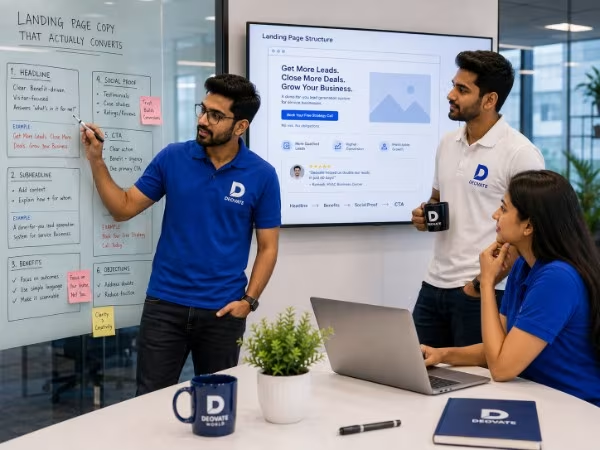
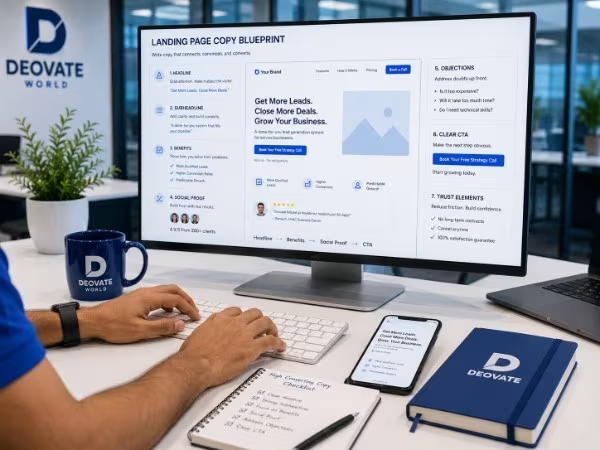
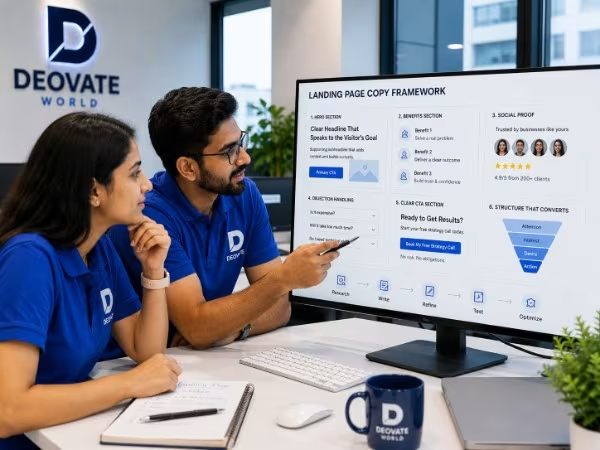
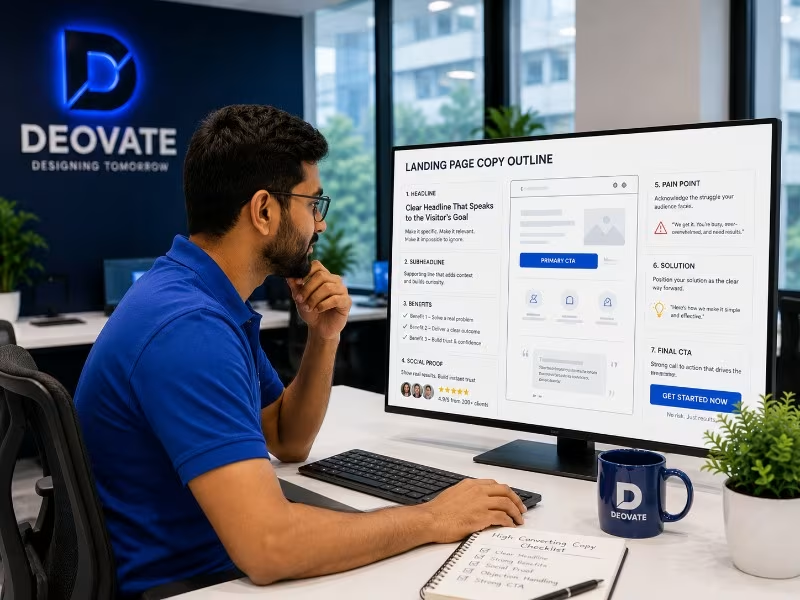
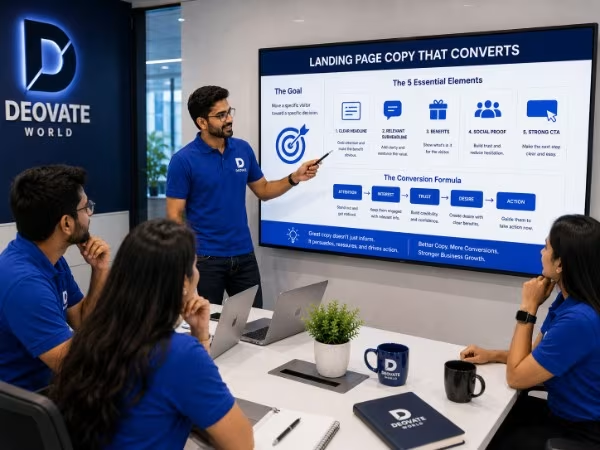
  1. A headline that speaks directly to the visitor\'s situation, not a clever tagline that requires context the visitor does not yet have.
  2. A subheadline that clarifies the specific outcome or benefit, answering the unspoken \"so what does this actually do for me\" question immediately.
  3. Specific, concrete claims rather than vague superlatives. \"Reduces checkout abandonment by identifying the exact friction point losing sales\" is more persuasive than \"the best solution for your business.\"
  4. Social proof placed near the moment of decision, not buried at the bottom of the page after the visitor has already decided to leave.
  5. One single, obvious call to action repeated consistently, rather than multiple competing options that force the visitor to choose between actions instead of just taking the one that matters.
  6. Copy that addresses the likely hesitation directly, rather than ignoring it and hoping the visitor does not think of it themselves.

Weak vs Strong Copy, Side by Side

Weak Version Stronger Version
\"Welcome to our innovative platform\" \"Stop losing sales to a checkout process that is quietly costing you customers\"
\"We are passionate about quality\" \"Every project includes a documented QA process before it ships\"
\"Learn More\" \"See How This Works For Your Business\"
\"Industry-leading solutions\" \"Used by 200+ businesses to cut checkout abandonment by an average of 18%\"

Why Specificity Consistently Outperforms Polish

Vague, polished language feels safe to write because it is difficult to be wrong about, \"industry-leading\" and \"innovative\" are claims nobody can really challenge, but they are also claims nobody genuinely believes, because every competitor makes the exact same claim in the exact same words. Specific claims, a real number, a real mechanism, a real named outcome, carry more persuasive weight precisely because they are falsifiable and therefore feel more credible, even though writing them requires more actual thought and, often, more honesty about what the product genuinely does well.

Addressing Hesitation Instead of Hoping It Does Not Surface

Every visitor arrives with some level of skepticism or hesitation, is this actually going to work for my specific situation, is this company legitimate, is the price justified. Copy that pretends this hesitation does not exist, focusing only on positive claims, leaves that doubt fully intact in the visitor\'s mind, unaddressed and free to grow as they consider leaving. Copy that names the likely hesitation directly, and then addresses it honestly, often converts better than copy that simply avoids the topic, because it demonstrates the business actually understands the visitor\'s situation rather than reciting a generic pitch.

The Discipline of Testing Instead of Guessing

Even genuinely skilled copywriters cannot reliably predict which specific headline or call-to-action phrasing will convert best for a particular audience without testing, because conversion behavior depends on factors, audience psychology, competitive context, specific traffic source, that are difficult to fully anticipate from a desk. Treating landing page copy as a hypothesis to be tested, rather than a finished, permanent artifact, is what separates pages that steadily improve over time from pages that were written once, based on best guesses, and never revisited regardless of how they actually perform.

Final Thought

The goal of landing page copy is never to sound impressive in isolation, it is to move a specific visitor, with a specific need, toward a specific decision, as clearly and honestly as possible. Every sentence on the page should be evaluated against that single standard, not against how polished or clever it sounds when read out of context.
Gallery

Written by
Swati Mishra
Swati Mishra
Healthcare Educator
Have a project in mind?

Let's talk about how we can help bring it to life.

Contact Us
Leave a Comment

Share your thoughts on this article

Comments are reviewed before they appear publicly.

0 Comments

Be the first to comment on this article.

More Articles

Brand Identity Mistakes That Are Quietly Costing You Trust

Brand Identity Mistakes That Are Quietly Costing You Trust

Most branding mistakes are not dramatic, they are small inconsistencies that quietly accum...

ERP vs CRM: What Growing Businesses Actually Need First

ERP vs CRM: What Growing Businesses Actually Need First

These two systems get confused constantly, and businesses often invest in the wrong one fi...

Why Skipping QA Testing Costs More Than It Saves

Why Skipping QA Testing Costs More Than It Saves

Skipping or shortcutting QA is one of the most common cost-cutting decisions teams make un...

Our Development Process

From Vision to Digital Success

Every project we take on moves through the same four stages, not because we lack flexibility, but because skipping steps is exactly how good ideas turn into messy builds. Here's what that looks like in practice.

01 Discovery
02 Planning
03 Development
04 Launch
Deovate/process
Trusted by Businesses Worldwide

What Our Clients Say

Discover how our technology solutions have helped businesses innovate, grow, and achieve lasting success through trusted partnerships and measurable results.

Deovate/reviews
Start Your Digital Journey

Let's Build Something Exceptional

You've seen how we think and how we work. Here's where it turns into your project.

You've read about how we think, who leads the work, and what a project with us
actually looks like day to day. The next step is simple: tell us what you're building, and we'll tell
you honestly whether we're the right fit - and if we are, exactly what that plan looks like.

Start Your Project
FAQs

Frequently Asked Questions

Still have a question after reading about our team and process? Here are the ones people ask most.

Deovate

FAQs

Quick answers to common questions

What's the biggest difference between landing page copy that sounds impressive and copy that actually converts?

Copy that converts speaks directly to a specific visitor's specific problem and the decision they're actually facing right now, while impressive-sounding copy tends to focus on broad claims and abstract benefits that could apply to almost any business. The clearer and more specific your copy is about the exact outcome a visitor wants, the more it moves them toward a decision, compared to vague language that sounds good but doesn't actually address what they're there for.

Should landing page copy be short and punchy, or longer and more detailed?

It depends entirely on what decision you're asking the visitor to make - a low-commitment action, like signing up for a free resource, generally needs less copy, while a higher-commitment decision, like a significant purchase, usually benefits from more detailed copy that addresses real objections and hesitations. Length isn't inherently good or bad; the real question is whether every part of the copy is doing genuine work toward the decision, or just padding.

How do you write copy for a visitor you've never actually talked to or met?

By grounding it in real customer language rather than guessing - actual words and phrases customers have used in reviews, support conversations, or sales calls tend to resonate far more than generic marketing phrasing a copywriter invented in isolation. This is exactly why gathering real customer feedback and language before writing landing page copy tends to produce something that actually connects, rather than copy that sounds fine internally but misses how customers actually talk about their own problem.

Is it better to focus copy on features or on benefits?

Benefits framed in terms of the visitor's actual outcome, generally, though features still matter as supporting proof once the benefit has captured interest. Leading with a feature list before establishing why any of it matters to the visitor's specific situation tends to lose people before they connect the dots themselves - the copy needs to make that connection explicitly rather than assuming the visitor will do it on their own.

How much should urgency or scarcity be used in landing page copy?

Sparingly, and only when it's genuinely true - a real, limited-time offer or genuinely limited availability can ethically and effectively motivate a decision, but fabricated urgency erodes trust the moment a visitor notices it's not real, which is easier for people to spot than businesses often assume. Overusing this tactic, or using it dishonestly, tends to damage credibility more than it helps conversion in the long run.

Does the headline really matter that much, or is it overrated compared to the rest of the copy?

It matters enormously, since a meaningful share of visitors decide whether to keep reading based on the headline alone, before ever reaching the supporting copy beneath it. A weak or vague headline can undermine genuinely strong copy below it, simply because visitors never get far enough to read it. This is exactly why headline testing and iteration deserves real, deliberate attention rather than being treated as an afterthought once the rest of the page is done.

Should every landing page have a single, clear call to action, or is offering multiple options better?

Generally a single, clear primary call to action converts better than presenting multiple competing options, since every additional choice adds a small amount of friction and hesitation to the decision. There are exceptions for pages genuinely serving different visitor intents, but even then, one option should be clearly primary rather than presenting several equally-weighted choices that force the visitor to also decide which action to take.

How do you know if landing page copy is actually working, or just sounds good to the people who wrote it?

Real conversion data, through proper testing, is the only reliable answer - internal opinions about whether copy 'sounds good' are notoriously unreliable, since the people writing and reviewing it already understand the business too well to judge it the way an unfamiliar visitor actually would. A/B testing different versions against real traffic removes that internal bias and shows what actually moves people to act.

Does landing page copy need to be different for different traffic sources, like ads versus organic search?

Often yes, since visitors arrive with different context and expectations depending on where they came from - someone clicking a specific ad already has certain expectations set by that ad's messaging, while someone arriving from a general search may need more context established from scratch. Matching the landing page message to the expectation set by the traffic source tends to reduce the disconnect that causes people to bounce immediately.

What's the realistic first step to improving an existing landing page's copy?

Gather real customer language - from reviews, support tickets, sales call notes - before rewriting a single word, since that raw material is what makes copy actually resonate rather than sound generically polished. From there, focus first on the headline and primary call to action, since those tend to have the largest impact on conversion relative to the effort involved in changing them.

Deovate

Get In Touch

We'd love to hear about your project

Please enter your name.
Please enter a valid email.
Please enter a valid phone number.
Please enter a subject.
Please enter a message.

Thanks! Your message has been noted.

Book a Meeting